
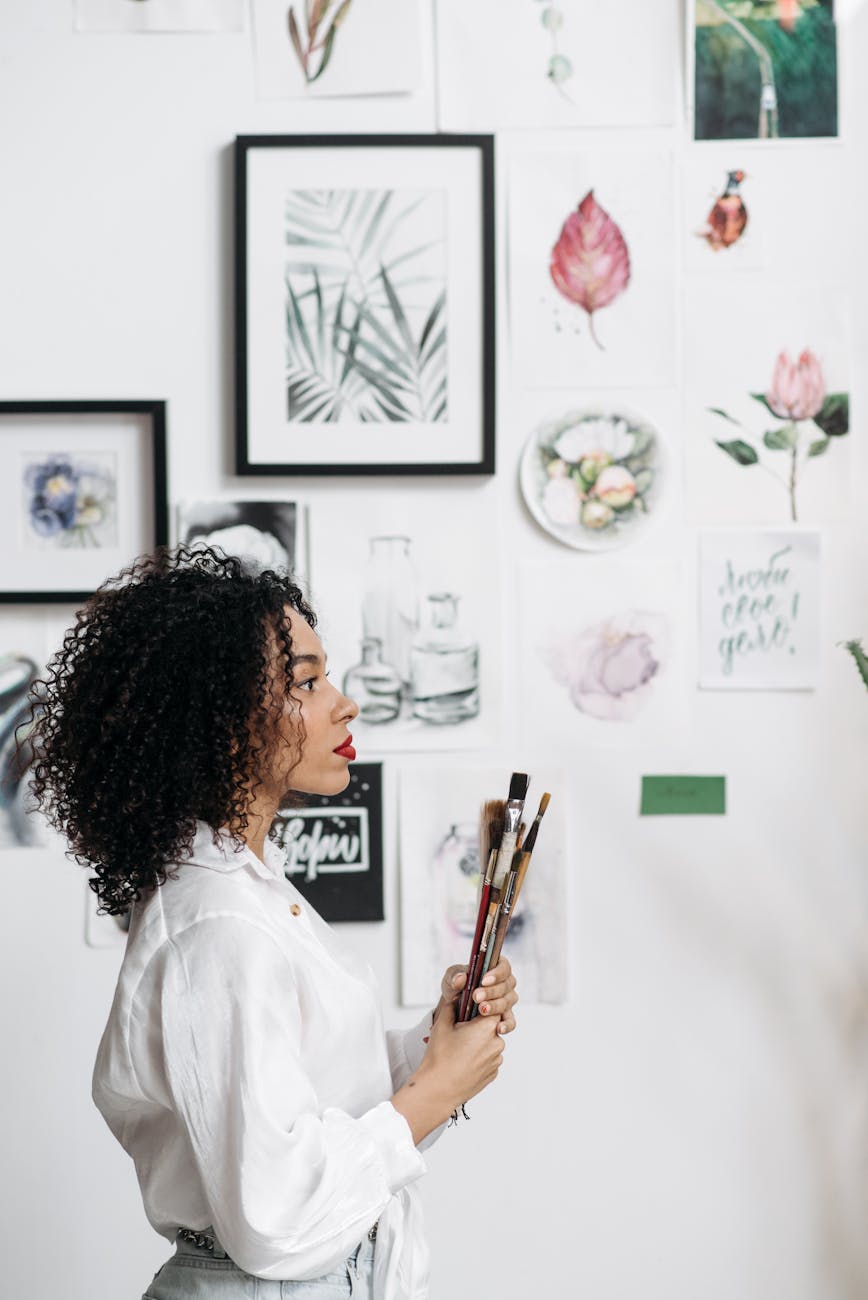
Art by men is valued considerably higher than art by women. This is a renowned and indisputable fact.
As this article in the Guardian highlights, for every £1 fetched by a male artist’s work, one by a woman gets a mere 10p (and if this statistic isn’t already shocking enough, its value plummets yet further still if she signs it)…
To put some real examples to the above, consider the most expensive painting ever sold by a man (or woman)– Salvator Mundi by Leonardo da Vinci. In 2017, Da Vinci’s work fetched a staggering $450m at auction. In contrast, however, the most expensive painting ever sold by a woman, Jimson Weed/White Flower No 1 by Georgia O’Keeffe, sold for considerably less, $44.4m in 2019. This shows the discrepancy in how art is valued based on the artist’s gender (a 164.078% discrepancy, to be exact) …
Although countless organisations exist to shine a light on such inequality, one example of which is the Guerrilla Girls, a group which formed in response to MoMA’s 1984 exhibition whose ratio of female to male artists was a shocking 13:156, we don’t want to merely recognise what is happening within the arts but ask why it is happening.
Why, when women earn 65–75% of master of fine arts degrees in the U.S., are only 46% of working artists women? Similarly, why, when 64% of art and design undergraduates in the UK are women, are 68% of the artists represented at top London commercial galleries men?
It’s not that women just aren’t ‘good’ at art, clearly. A far greater proportion of women graduate from art school than men. It’s that women have, for centuries, been regarded as ‘lesser than’ their male counterparts through no fault of their own.
The existence of the patriarchy
Misogynistic views rooted in the patriarchy still see society viewing women as being worth less than men. Even little things that we overlook, such as women generally taking the surnames of their partners when they marry, serve to contribute to the patriarchy being upheld.
To focus on women taking their partner’s surnames for a moment, this means that when female artists sign their work, they are essentially attributing it to their husbands, therefore further contributing to the notion that women don’t create art, let alone ‘good’ art.
A vicious cycle is then created.
With a lack of female artists in the media, the phrase ‘you can’t be what you can’t see’ rings ever truer. How can anyone give art created by women the same level of respect as they give art created by men when all they see is the latter? It’s just not going to happen. For it to happen, we need to see a societal shift in attitudes towards female artists.
First, however, we just need to see female artist’s full stop.
Women shouldn’t have to sacrifice being honest about who runs their business in order to stay in business, but unfortunately, that is what is happening today.
Where are all the women?
In 2017, two women, Penelope Gazin and Kate Dwyer, decided to start an online art marketplace. It didn’t, however, take long for them to notice a pattern…
In many cases, the external developers and designers that Gazin and Dwyer enlisted to help took a condescending tone over email. These collaborators, who were almost always male, were often ‘short, slow to respond, and disrespectful in correspondence’. In response, Gazin and Dwyer introduced a third cofounder: Keith Mann, a fictional character who could communicate with outsiders over email.
“It was like night and day,” Dwyer said in an interview with the Fast Company. “It would take me days to get a response, but Keith could not only get a response and a status update but also be asked if there was anything else that he needed help with.”
In exchange after exchange, the perceived involvement of a man seemed to have an effect on people’s assumptions about Gazin and Dwyer’s business, therefore prompting me to ask the question, again, of…
Why are men held on such a pedestal?
A combination of the patriarchy, misogyny, and the cause of it all, man’s massive ego, we cannot have this in our future.
Alas, for something that is all about breaking down walls, the art world sure does love to keep a pile of bricks on hand… However, with greater awareness of what is happening within the industry, as well as across all the industries in society at large, we can get rid of those bricks once and for all. For the first time ever, men, women, and everyone in between can all start from a level playing field.
For artists to be known, not for their gender, but because of what they do and what they support… This is the goal.

 ANARKISS