
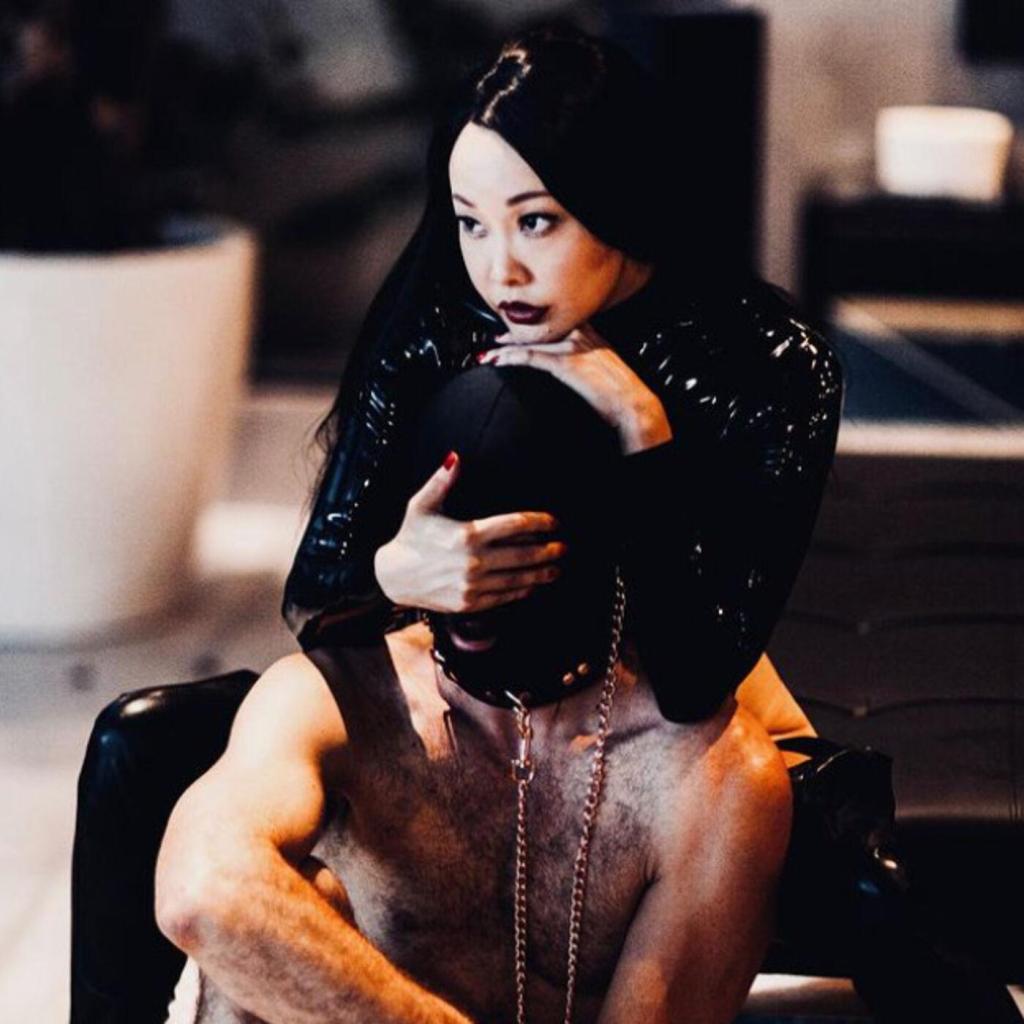
In recent months, our posts exploring the history of sex work have sparked a notably divided response, drawing in a chorus of voices that frame sex work as inherently exploitative, inseparable from capitalism, or as reinforcing patriarchal structures.
Those critiques aren’t new, but they often flatten the lived realities and agency of the people within the industry itself. In this exclusive EVA OH X ANARKISS interview, speaking with Eva Oh offers a necessary counterpoint. As a dominatrix, writer, and educator, Eva embodies a form of self-defined power that resists easy categorisation.
Her work not only challenges traditional expectations of female submission but actively reframes desire, control, and labour through a lens of autonomy. In a conversation that moves between the personal and the political, Eva makes clear that agency in sex work isn’t theoretical; it’s lived, negotiated, and, in her case, unapologetically claimed.
‘When people don’t understand their own power, desire feels threatening.’
1) How do you define what you do?
‘Dominatrix’ is a job description of someone who carries out fetish fantasy role-playing, indulging people’s fetishes and desires for a specific period of time, for an agreed-upon monetary amount.
On top of that, my career has also evolved into writing, podcasting, influencing (she says with a mock gag), a Patreon mentorship platform, ‘I even made a tee and a leather utility belt once upon a time.’ & I do talks, and as many interviews as I can, to spread the good word of BDSM and sex work.
2) Women are expected to be submissive. How does your work challenge that?
A lot of women have outward expressions of submission in how they interact with the world. My work centralises the idea that, not only does a woman have agency, but an agency to assert direction on the world around her. That is something that has always been a part of my nature – to lean into that assertiveness, and I found a home for it, and a complimentary factor: that there are a lot of men who worship that way of navigating the world, or at least fetishise it, which can lead to learning how to actually centre it, Eva says with a laugh.
3) Do you see femdom as political, personal, or both?
It started off for me as a personal expression of realising what my personality was, and why someone jokingly suggested starting this thing that I’d never heard of (dominatrix work).
Over time, I’ve come to understand that female dominance is an approach or a concept that is quite challenging to society. And also, as a sex worker, I’ve come to understand why these identities/choices are challenging, and the structures that sideline these as ‘options’ or as ‘freedoms.’ And so, it has become more and more political for me personally, also.
4) Do you see your work as part of queer resistance to norms around gender and desire?
This is something that I am still fleshing out in my brain and my understanding. I don’t have as much of an education in the vocabulary of gender dynamics, and it’s really something that I didn’t grow up with at all, and it’s been something that I’ve had to learn. Sitting within this work has been an interesting perspective to learn it from.
Similarly to how I entered femdom, without understanding that it was something that sat within me, I entered a workspace that is very queer, without understanding that I was queer.
The workspace is queer because a lot of the folks who work within it identify and live as queer. Femdom introduces not only the resistance, but the complete expression away from norms.
In how they’d interact with each other/the things they’d share, over time, I began to understand where I sit within that.
I don’t articulate queer resistance as strongly as I do other aspects of my work because I don’t get as much opportunity to speak about it, and therefore learn how I think about it. This is the first time someone’s actually asked me directly.
The interactions that I illustrate through media is my way of representing that aspect (queerness) of potential being. Do I see femdom as inherent to that? Not necessarily. It’s about how the complexity of an individual expresses itself, and it does happen to express itself within me, and therefore within the resistance that I put out into the world.
5) Is desire the threat, or is the threat who is allowed to feel it/hold it/weaponize it?
It’s all of these things.
Desire as the threat:
I think that when an individual doesn’t understand the power that they could have, that desire is a threat to them. I often observe in my work the way that people relate to their desire. I think it’s a challenge to the tiny little boxes that they’ve been taught to situate themselves in, and it’s quite threatening, quite terrifying. Desire shows a way out of that box, but whether the person wants to take that way out is a whole other thing.
Who’s allowed to feel it as the threat:
From a societal lens, it’s all so integrated. I think there’s a fear in that light out of the box on an individual level, and when people have that collectively, the fear of who’s holding what, and who’s holding what instead of me, and who can hold that against me, I think it’s a fractal sort of process, and it just explodes and implodes upon itself. The internal fear is multiplied into the sphere of society, and the idea of weaponizing vs owning.
6) Where does power blur into vulnerability for you?
I think, for me especially, they are one and the same. I think that when I am so at ease with my vulnerability, that’s what makes me unshakeable, and from that unshakeable space, I end up moving through the world. It is that vulnerability, that friendliness with my vulnerability, that is how I’m able to stand my ground, and receive and give, and I think that is what power is for me.
7) What do people get wrong about you?
I think it ties in with question 5 – the desire, the ‘box’, the light out of the box.
I think that when I talk to folks, and they look at me, and they have an assumption, it’s their fear, and you can dispel that, not with too much difficulty, with understanding and compassion, actually. What does their fear inspire them to think? That the job is a shallow exchange, and I think that, like anything, anything can be a shallow exchange, sure, but I think to be long-lasting in work as a sex worker/as a dominatrix, especially an ‘out’ sex worker/dominatrix, it’s forever.
The assumption of sex work is that it’s shallow. The reality, however, is that you have to have understood the world in a more complex fashion that can be integrated into who you are, so that you become more resilient to the shallow ‘wrongs’, and you become less shallow yourself.
8) What does pro-sex-work actually mean in practice, not just in theory?
Like the queerness, I’ve had to learn this aspect (‘and I’m always learning’, Eva reiterates), and for me, it’s been a big process.
I came from a world where nobody talked about sex work, or ‘prostitution’, as I knew it, and I recoiled at the mention. I did all those things. It took years in the job, and an internship at a sex work organisation, where they taught me about decrim and all of these things, in order to write position papers for them.
Pro-sex-work means keeping your heart and your ears and your eyes open to actual sex workers, and the things that they feel and say and do and want for themselves. I think that’s probably at the core of it. It’s also about educating oneself about the things that can actually support those sex workers, namely, decriminalisation, having understood/read the reports, etc. It has to be a very comprehensive and educated approach these days, because it’s such a tough fight to fight, and you need that grounding and that foundation. It’s that as a basis, and then showing up if someone says something uneducated about the work. Showing up when someone needs you to write a letter to an MP. Showing up in a way that you know that you can, and offering that, and being available for it. I think that being on the process/the ‘path’, and not doing that in isolation, is important.
9) What’s a question that people avoid asking you?
It’s quite interesting, actually. When you say that you have anything to do with sex, people’s filters really drop away, and they tell you all sorts of weird shit about themselves where you’re just like… ‘I’m not your therapist’, Eva says, laughing. After they get past the initial shock, they’ll tell you everything.
10) Where can people support you?
To support me, do question 8.
Listen.
Listen to the folks in your life, or in the world, who are not the folks that get that major platform. Seek out something that’s going to challenge your opinion. Seek out the thoughts of the marginalised. I feel like that’s how you can support me (and yourself). But if you do want to find me, all the links are on my website: eva_oh.com, and I usually post everything up on Instagram: youwillplease_me.
I also have a Patreon now that I do monthly live Q&A’s, and we have a Discord chat, and it’s a great little community in there. I have quite a few bigger projects coming out, but I’m not allowed to talk about them yet!
Eva Oh, everybody.
 ANARKISS