
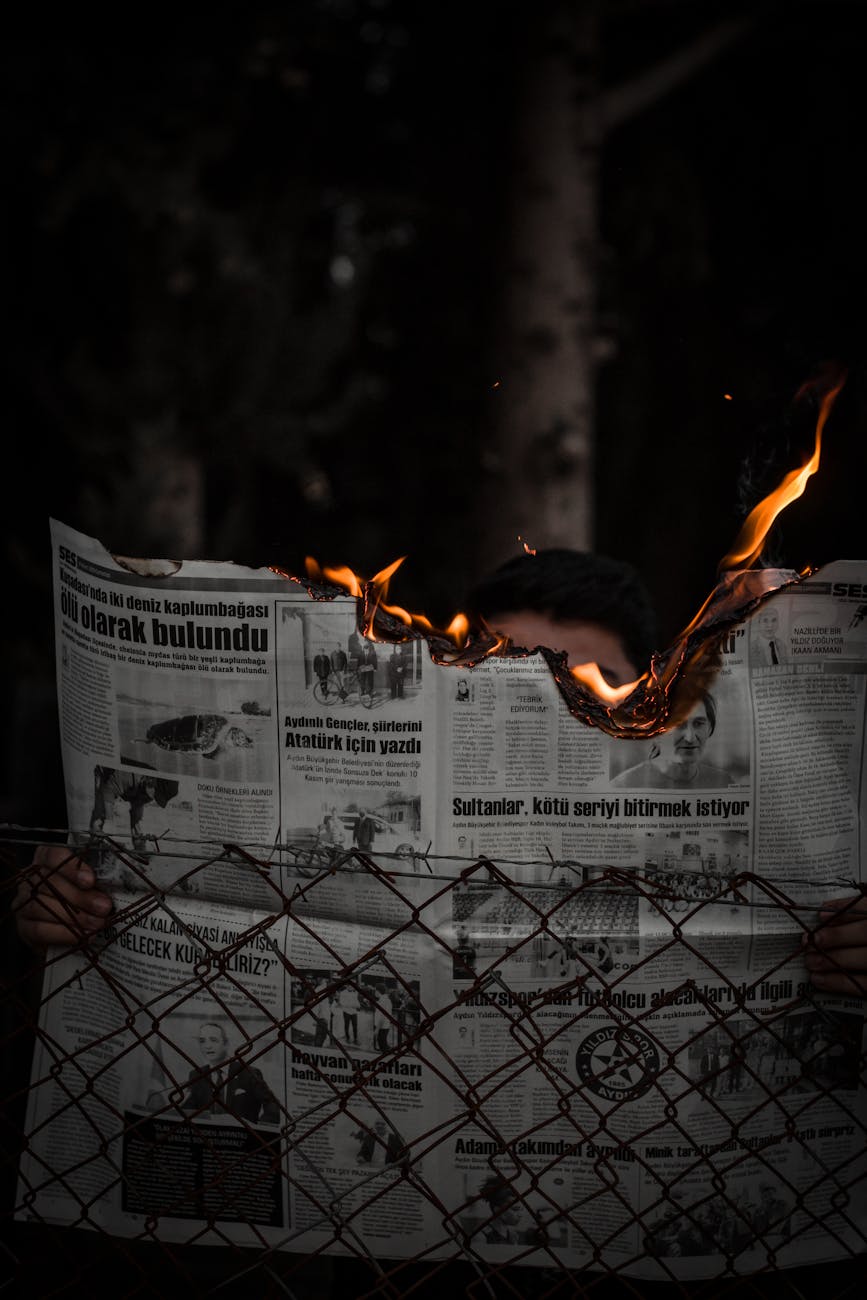
Few people have the courage to demand change in a society that tells us that there is nothing to change. Or, in the rare instances when society does accept that change might be needed, ‘you’re not the one to deliver it’, they tell us.
It’s why artists who create experimental art face so much retribution, with the unveiling of a new piece being met with, not congratulations or pride, but ‘how dare you go against the status quo.’
Society hates change.
As the root cause of censorship, noun: ‘The prohibition of anything considered obscene, politically unacceptable, or a ‘threat to security’, it is because of society’s disdain for change that our artistic freedom is violated.
Despite artists being the best people to deliver change, with change being to art what love is to poetry, (the ultimate muse), artists are all too often silenced for questioning norms (social and religious) or expressing political views that oppose the dominant narrative.
‘If you give artists freedom of expression, soon every American will want it’, the custodians of morality (men) say.
The censorship of art is all but an exertion of male authority.
And where do such remarks come from?
A place of fear.
Change threatens the place of those with power in society, hence why they are so vehemently against it…
What the people in power don’t realise, however, is that the rationale behind their opposition to art is counterintuitive to what they are trying to achieve.
When marginalised voices create art to get their voices heard in a society that demands that they move through the world in silence, silencing them via the oppression of their art only serves to justify the necessity of the arts even more. But, even so… Silenced they have been, particularly when it comes to LGBTQ+ people, women, people of colour, and anyone who questions the role of religion in society.
To focus on the former demographic, LGBTQ+ people, (lesbians in particular), while sex between consenting women is not illegal, silence is the weapon of their oppression.
In 1921, a conservative member of Parliament, Frederick Macquisten, argued that ‘Acts of Gross Indecency Between Female Persons’ should be added to the Criminal Law Amendment Act of 1885.
How can you legislate against something that is human nature?
Lesbianism, he told the House of Commons, ‘threatened the birth rate, debauched young girls, and induced neurasthenia and insanity’, and such practices, Macquisten believed, would cause contagion, for in the home of his mind, a woman’s place was on his arm and in his bed only…
While the law was never passed, Macquisten’s campaigning led to censorship laws being introduced in Britain and America that prevented lesbians from publishing anything, whether fact or fiction, about their love lives.
It wasn’t just lesbians who were subject to such discrimination, either. Straight women were also tarred with the same ‘you do not belong here’ brush…
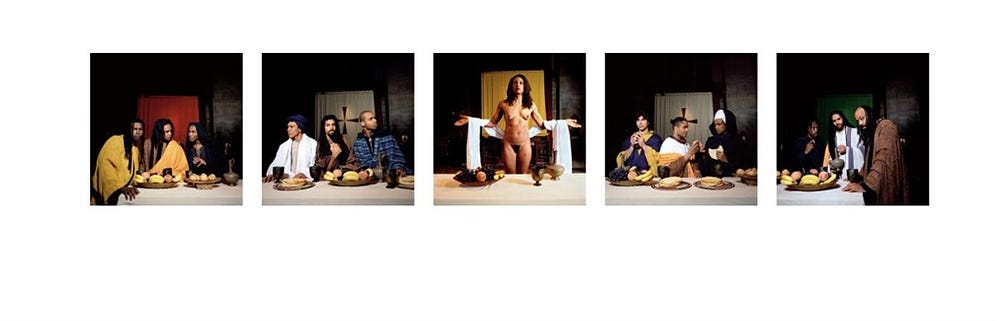
In 1996, Jamaican American artist Renée Cox made headlines for her controversial piece of art, ‘Yo Mama’s Last Supper’ (above). The piece was a remake of Leonardo da Vinci’s “Last Supper” (1494), with a nude Cox sitting in for Jesus Christ.
Many Roman Catholics were outraged by Cox’s depiction of the Last Supper. ‘“I think what they did is disgusting, it’s outrageous,” the former associate attorney general of the United States, Mayor Rudy Giuliani, said.
In response to her critics? ‘Get over it!’ was all Cox had to say. ‘Why can’t a woman be Christ? We are the givers of life!’
Unfortunately, though, what is anatomically provable (woman birthed man), is wrongly said to be disprovable by what is nothing more than a fairytale (man birthed woman from his rib) …
The 19th-century French painter Gustave Courbet also caused controversy from a patriarchal perspective with his painting titled ‘Origin of the World’ (1866).
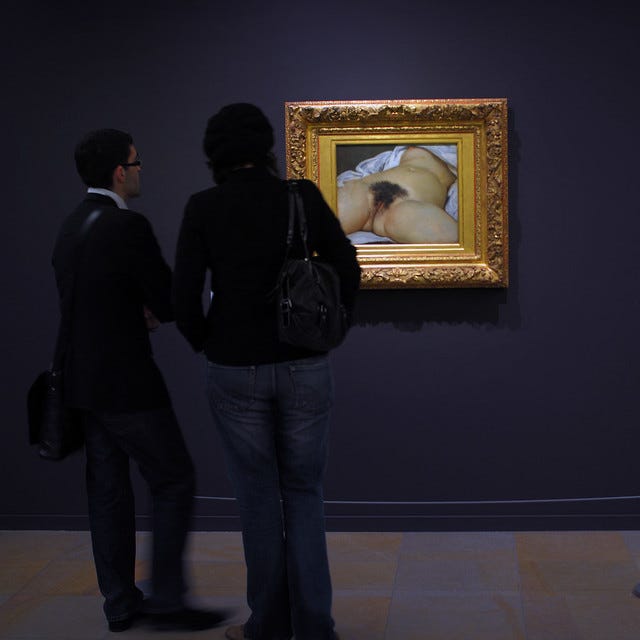
The close-up depiction of the genitals and abdomen of a female nude lying on a bed with her legs spread has long been a subject of obscenity laws, with some feminists arguing that the painting is a powerful symbol of female sexuality and liberation, while others see it as objectifying and degrading.
The same is true of Robert Mapplethorpe’s photography, too, whose work is deemed at once both liberating and degrading…
Is it outrageous, or is it a truthful exploration of the human body, sexuality and desire?…
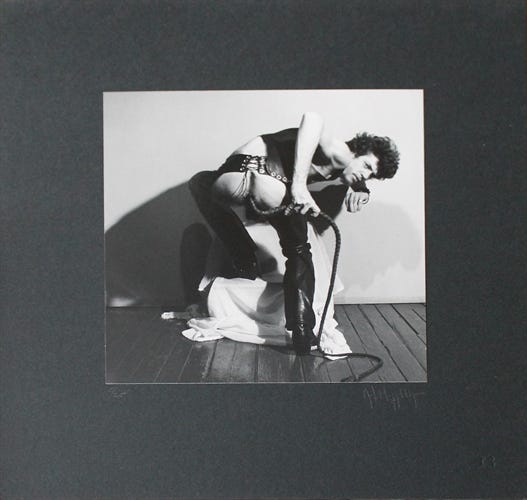
In the 80s, Robert Mapplethorpe’s photographic scenes of sexual domination and bondage caused a stir in the art world.
In his photographs, Mapplethorpe was portraying, not only gay sex, which was a taboo in itself, but sadomasochist gay sex, to intentionally provoke a prudish America.
Among his most controversial works, there was a self-portrait within which Mapplethorpe had a bullwhip in his anus, as well as photos that he had taken of his friends. There are many, too many to list here, but two that spring to mind are titled, ‘Fist Fuck / Full Body’, which is a photograph of a man elbow deep in another man’s anus, and ‘Jim and Tom, Sausalito’, which is a photograph of a man (Jim) urinating in another man’s mouth (Tom).
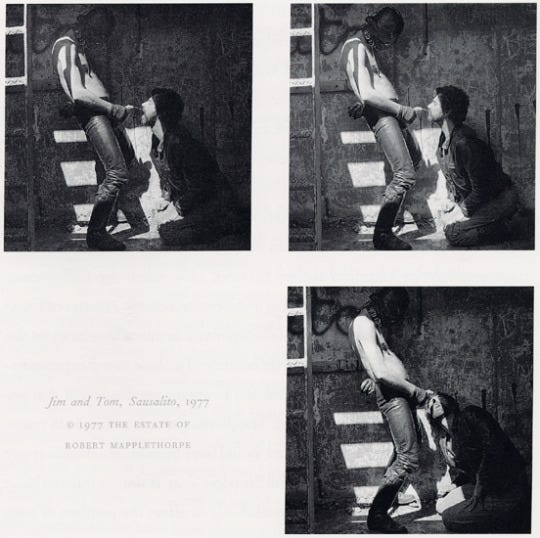
Arts ability to shock in ways that create long-lasting impacts on audiences is a testament to the power that it holds in society.
So shocking to the public were Mapplethorpe’s photos that displaying them led to one museum being taken to court on criminal charges for the first time ever as a direct result…
Fortunately, jurors decided in the museum’s favour, agreeing that art doesn’t have to be pretty or ‘nice to look at’ for it to be of value, but the fact that people are still scared to write about certain topics, or paint certain subjects, or take photographs that depict certain things today is proof that there is still work that must be done to ensure that artists are granted the permission to be just that… artists.
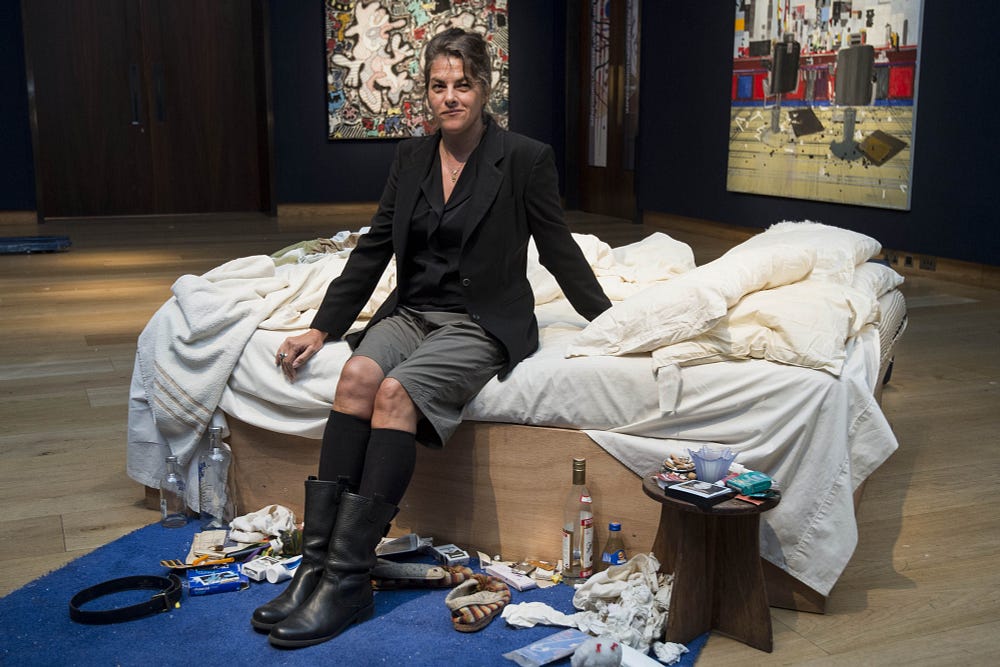
Unfortunately, someone who didn’t quite pass the obscenity check like Robert Mapplethorpe was the author of Ulysses, James Joyce.
Ulysses was first published in 1918 in a small magazine called The Little Review. However, due to the sexual content and blasphemous language within the book, it wasn’t long before it was banned in English-speaking countries around the world, and The Little Review’s Editors, Margaret Anderson and Jane Heap, were tried under obscenity.

‘It sounds to me like the ravings of a disordered mind — I can’t see why anyone would want to publish it’, one judge said of Ulysses, the assumption being that its characters would lead women down a path of ever-expanding permission ending in broken families and a ruined nation.
Exploring sexual pleasure outside marriage could lead to questions about the wisdom of marriage and monogamy itself, which opened the door to questioning all unexamined pieties, including nationalism, capitalism, and religion.
As such, Anderson and Heap were found guilty, fined, and ordered to cease publication.
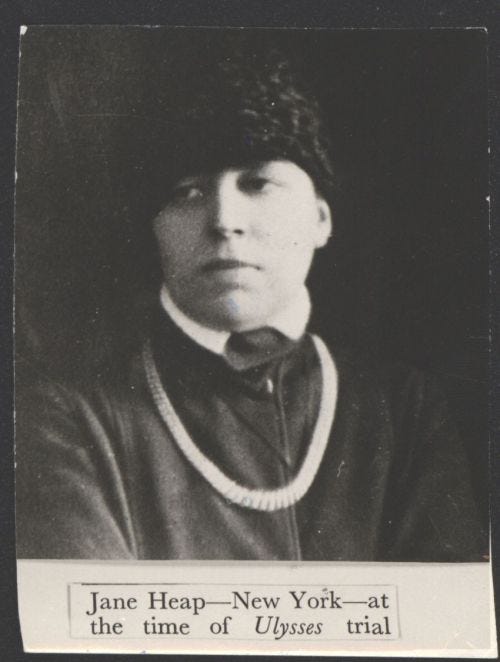
For many readers, as well as Joyce’s literary contemporaries, the idea that Joyce’s experimental work had been banned as obscene was absurd. For many legislators, journalists, and other readers, however, the book was pornographic and blasphemous.
Alas, if art is to be successful, it must reflect the world in its entirety, including the so-called ‘distasteful and obscene’ aspects.

To ban art is to ban humanity.
One cannot be an authentic artist under fear of censorship, for censorship is the antithesis of the freedom of expression that is art.
 ANARKISS