
My partner and I are both interested in art and history and, as lesbians, we love to delve into queer history in particular. Berlin offers tourists an unrivalled opportunity to experience queer history, in all its glory…
Armed with a burning curiosity and an eagerness to discover all that the bustling city had to offer, we arrived in the German capital at the fall of dusk on Friday the 15th of November 2024.
The journey from the UK was a short one. It took just two hours for us to get from Birmingham airport to Brandenburg, and from there, half an hour in an Uber to get to our hotel.
While there are hundreds of places to stay in the German capital, we chose the Arte Luise Arthotel based on its description of being an ‘art gallery to stay in overnight.’
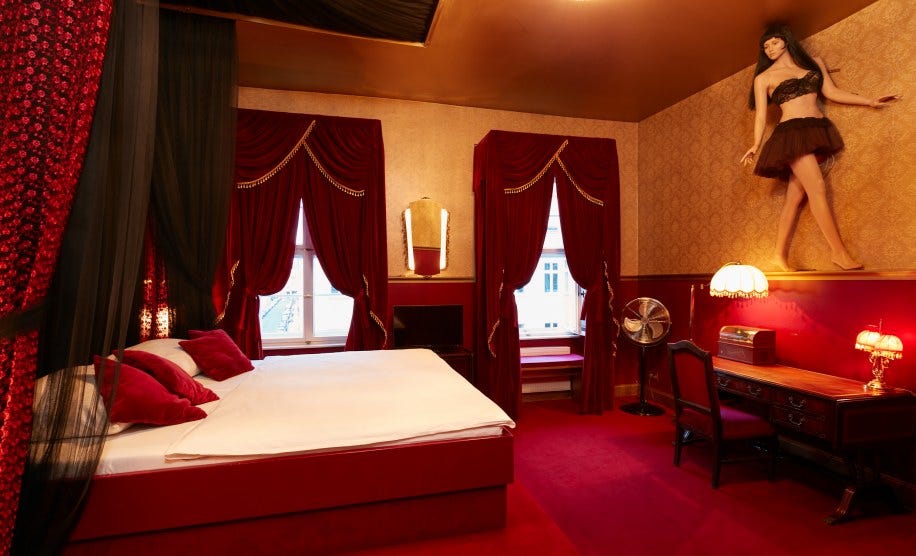
For the next three nights, we took residence in room 206, the ‘Cabaret’ room.
Red velvet and brocade, the bed draped with lace and exposed on a pedestal, with red lights, erotic dancers and the sounds of the old Paris-Moscow trains carry the guest back in time to the atmosphere of the establishments of the 1920s and the old Berlin of Christopher Isherwood*.
*Isherwood’s best-known work is Goodbye to Berlin (1939), a semi-autobiographical novel which inspired the musical Cabaret (1966).
A fitting tribute, one could say, for where we were to venture to the next day.
But first, the important stuff…
Whilst in Berlin, we both felt that it was important, no matter how upsetting it might be, to visit the Memorial to the Murdered Jews of Europe.
An installation designed by architect Peter Eisenman and Buro Happold, the memorial, as pictured below, is a work of art in itself.
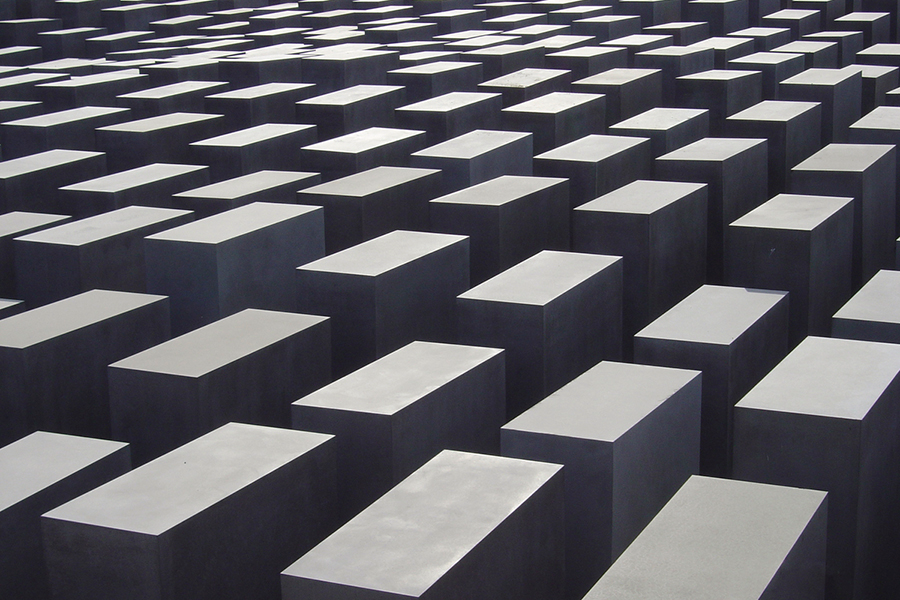
Eisenman placed 2711 concrete stelae of different heights on a site covering 19,000 square metres. Its openness and abstractness gives visitors space to confront the topic in their own personal way.
It represents whatever you think it represents. That is the beauty of it.
We also visited the Sachsenhausen concentration camp while we were in Berlin where, in the years between 1936 to 1945, more than 200,000 people were interned.
Those targeted included political opponents of the Nazi regime, members of groups declared by the Nazis to be racially or biologically inferior, such as Jews, Roma and other people derogatorily labelled as ‘Gypsies’, people persecuted as homosexuals, as well as social outsiders who were labelled as ‘antisocials’ and ‘career criminals’.

Located in what very much felt like ‘the middle of nowhere’, (it was, in fact, just North of Berlin), we had to catch a train from Hauptbahnhof (Berlin Central Station) to Oranienburg, and from there a connecting train to Sachsenhausen to get to the concentration camp. The journey was approximately 25 miles, and it took just shy of an hour.
We got there an hour before closing time, as dusk was setting and the rain was just beginning to pour down, and it made the experience even more emotional.
Walking around the grounds in what we considered ‘grim’ conditions (a bit of cold and rain), made us realise what those 200,000 prisoners must have felt.
The awareness that this was their life, but unimaginably worse, is hard to rationalise when you live in a free world.
It’s hard to rationalise, with the freedom that we have today, that even after the war, when the Nazis had been defeated and the concentration camps closed, that there would still be so much division in Berlin, the oppression of the Nazi regime being replaced with the oppression of the SSSR.

Post second world war, when Germany had surrendered, Berlin became occupied by several different (and opposing) forces, with the Soviet Union occupying the East under a communist state, and the US, the UK, and France occupying the West under a capitalist democracy.
Unsurprisingly, people in the East wanted to escape to the West, and so in 1961, a wall was built to divide the city into two halves.
The 27-mile-long stretch of concrete running through the city was comprised of two parallel walls punctuated with guard towers and separated by the “death strip,” which included guard dogs, landmines, barbed wire, and various obstacles designed to prevent escape. East German soldiers monitored the barriers 24/7, conducted surveillance on West Berlin, and had shoot-to-kill orders should they spot an escapee.
In 1989, however, on November the 9th, five days after half a million people gathered in East Berlin in a mass protest, the barrier that had divided Berlin and ripped families apart for 28 years finally came toppling down.

With the collapse of the Berlin wall came freedom, and with freedom, art.
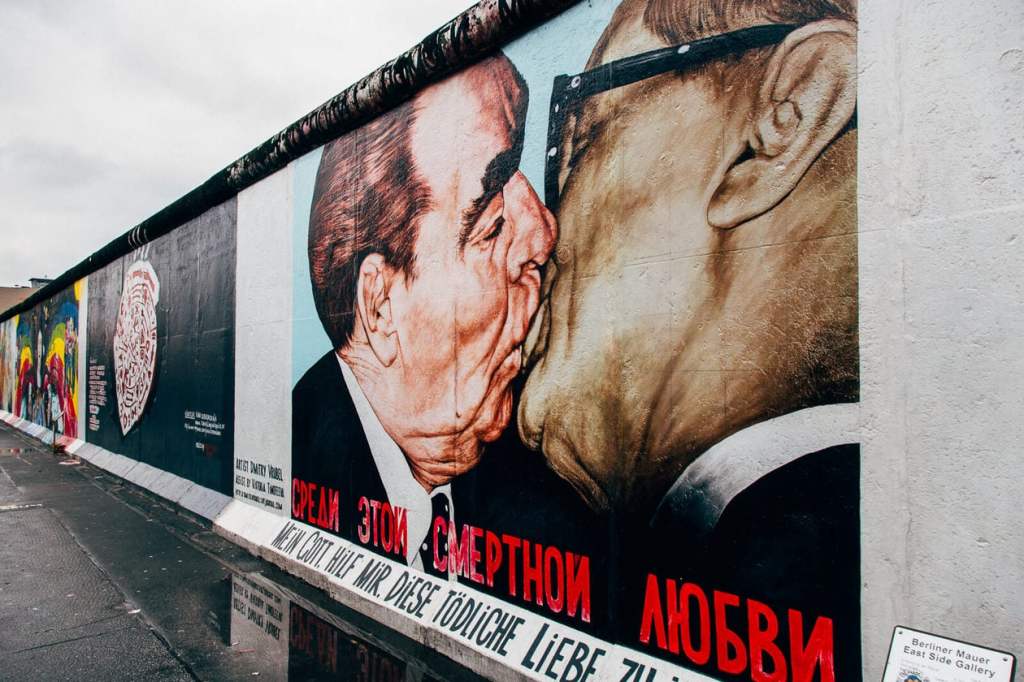
Welcome: East Side Gallery.
Today, what remains of the Berlin wall is home to more than 100 murals, painted by artists from all over the world, thus making it the largest open-air art gallery in the world, and the finest example of how art and activism can combine.

Splashing politically charged messages across Cold War barriers; the illegal status of graffiti only served to add to the political statement that the artists were trying to make.
‘What happens when freedom limiting laws are imposed? We break them’…
This is a sentiment that brings me nicely onto the final destination in our whirlwind weekend trip to Berlin, the KitKat Club…

If Weatherspoon’s is your go to pub and you squirm at the mention of sex, then the KitKat Club is probably (definitely) not for you. But before we get into all that, first, the history…
What is the KitKat Club, exactly?…
‘KitKat Club’ was the name given to the infamous gay nightclub in Cabaret, a musical based on Christopher Isherwood, an American novelist and playwright’s novel, Goodbye to Berlin.
Goodbye to Berlin, although fictional, is very factual in its storytelling of a city under attack.
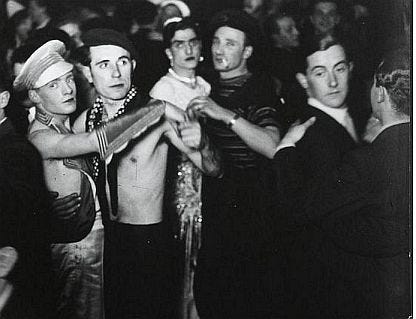
Isherwood’s writing largely mirrors his own experiences as a gay man who fled to Berlin at the age of 25 to find sexual freedom amongst the plethora of gay bars, such as The Eldorado, that the city had to offer.
The same sense of liberation and freedom that was sought in the clubs of twentieth century Berlin, as portrayed in ‘Goodbye to Berlin’ and Cabaret, can still be sought in the real-life KitKat Club of today….

Opened in 1994 by Austrian pornographic filmmaker Simon Thaur and his partner, Kristen Kruger, with a vehement sex positive attitude where patrons are allowed to engage in sexual intercourse openly, a visit to the KitKat Club is quite the experience.
To get in, remember the ‘undress’ code. If you turn up as a single man wearing jeans, a t-shirt, and a pair of trainers, you will be turned away by the two bouncers who stand at the door.
Less is more.
Once in, you can strip down even further, if that’s your thing. You wouldn’t be alone in walking around stark naked, in fact. Any bags or items of clothing that you want to shed can be stored alongside your phone (phones are not allowed on your person for obvious reasons, as the topless women behind the bar will tell you), to be collected at the end. And then… It’s time to explore!

Within KitKat Club there are several rooms to explore, accessible only by pushing through a crowd of sweaty bodies dancing to techno.
When the KitKat Club is more than just a nightclub, but a cultural institution, I, for one, wanted to experience all of it…
After adjusting to the environment that was unlike anything we had ever seen before, we made our way around the three-storey building, entering the dark room before being abruptly told to shut the door. ‘Nothing can happen when the door is open.’ I’m still a bit lost on the purpose of the dark room, if I’m honest… With sex going on in every room, what is its purpose, exactly?
Does the woman bent over with a guy’s penis sliding in and out of her mouth know him, or have they just met tonight? Who knows… Onto another room.
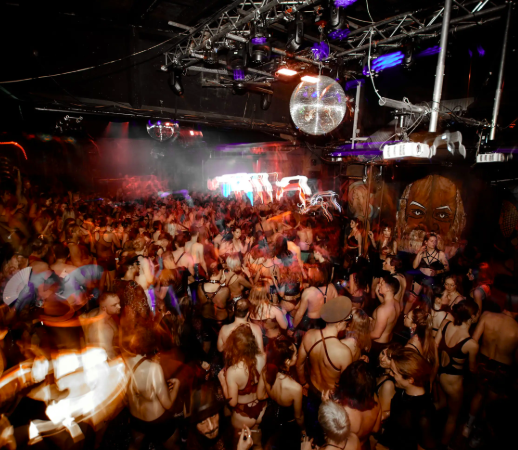
We carried on looking around, and unbeknown to me at the time, we entered a room that made everything glow in the dark. In it, there was a man who kept smiling at me, his teeth glowing in the dark. Because I was slightly (okay, maybe very) intoxicated at this point and had no idea what was happening, it scared me, and he must have been able to tell. ‘Are you afraid?’, he asked, and If I wasn’t afraid before then I was then… We left that room and went back downstairs to join the mass of sweaty bodies dancing. I can remember my girlfriend tapping me on my shoulder and looking up to see a woman being fucked over the railings upstairs.
Can you see why phones aren’t allowed now?…
What is allowed, however, is voyeurism, and in a venue where sex is essentially a (consensual) free for all, it’s to be expected.
In other words, you can’t venture into the KitKat Club and get mad when you stop kissing your girlfriend and see several men stood behind you wanking off like you’re there to put on a show for them. If the thought of that makes you want to vom, then I’d suggest that you give it a miss and stick to the trusted ‘spoons instead…
Go with a free spirit and an open mind, however, and you will see the best of Berlin. In every sense.

Would I go back?
With so many countries to see in the world, and so little time (and money) to visit them all, I’m usually a ‘once is enough’ type of person when it comes to travelling. With Berlin, however, and the amount of culture and history it has on offer, I would love to go back and do it all over again.
In the meantime, though, onto our next destination as I travel the world with the love of my life…
 ANARKISS