
When people get together in group settings, they are often subject to experiencing conformity pressures that can bias their ability to reason clearly and rationally. So obsessed are they in making the ‘right’ decision that people can subsequently lose sight of what they actually think for themselves…
They forget that they have the right to a personal opinion, blindly subscribing to whatever the ‘in’ opinion of the group is, whether they believe it or not, instead…
By no means a new phenomenon either, this concept, ‘groupthink’, has been a pressing issue for hundreds of years.
The eighteenth century saw the first wide-scale movement in trying to break away from such blind conformity, via the Enlightenment, also known as the ‘Age of Reason.’
Advocating for democracy, individual liberty, freedom of expression, and the eradication of religious authority, enlightenment is ‘man’s emergence from his self-imposed nonage.’*
*(‘Nonage’ being the inability to use one’s own understanding without another’s guidance)…
Many consider the Enlightenment a major turning point in Western civilisation, an ‘age of light replacing an age of darkness.’
Yet when two of the main schools of thought attached to the Enlightenment period, despite being proposed over three hundred years ago, are seemingly no closer to coming into fruition today;
1. That all legitimate political power must be “representative” and based on the consent of the people
&
2. That people should be free to do whatever is not explicitly forbidden,
evidently, we’re still sitting in the dark…
Political power is not representative when we are essentially living in a two-party state in which there is nothing that we can do…
Whether in the UK, in the case of Sunak VS Starmer, or in the US, in the case of Biden VS Trump (convicted felon vs probable dementia sufferer), we are forced to either not vote at all, or to simply vote for ‘the lesser of two evils’, neither of which should be happening in a so-called ‘democratic’ society…
We should not have to base our vote on who we want governing two of the most powerful countries in the world on who is marginally better/’slightly less of a bigot…’
As the former leader of the Labour Party, Jeremy Corbyn told the Standard last week:
Keir Starmer will win on an anti-Tory vote, not a pro-Labour one.
As I said, the ‘lesser of two evils’, where the person who’s been chosen as the candidate was nominated by nobody, selected by nobody, and imposed by the party head office…

When the election of a party leader is all done internally, yet as we have seen in recent years, who leads a party can completely change the direction of that party, we should have a say.
We can vote for the party, albeit only once every five years, but we can never vote for the leader of that party, unless we are either a serving MP or an official party member.
But again, when a new politician is elected as leader, and they then have the scope to change the party entirely to fit their image, how can we only have the right to vote for the party and not the person, when the person can completely change the party?
Make it make sense…
Consider Labour under Jeremy Corbyn, for example.
From 2015 to 2020, Corbyn, a staunch socialist, was in power, thus transmitting his values to the Labour Party and transforming the party further to the left.
After Labour lost the 2019 general election, however, Corbyn resigned, Starmer took over, and the party was moved further to the right.
As Rachel Reeves, shadow chancellor, told the Financial Times:
The party [labour] is completely unrecognisable compared to how it was a few years ago.
And as this CNN article writes:
‘To the left, he [Starmer] is someone who doesn’t have the conviction to make radical changes and, once in office, will not be materially that different to a Conservative leader.’
The fact is that politicians say what they have to say to get in power, but once they’re in power, they’re just as quick to abandon their policies as they were to make fingers-behind-the-back-crossed promises…
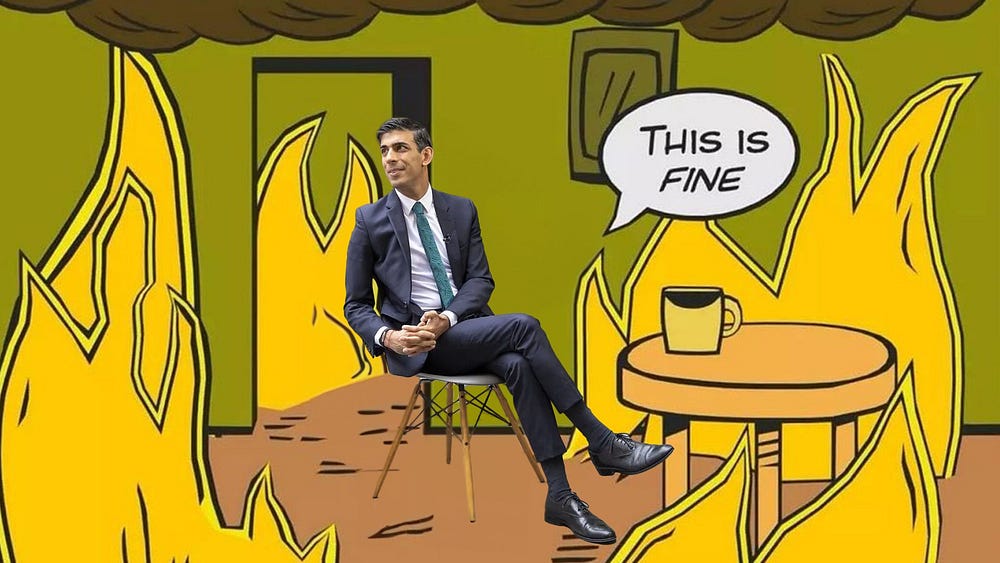
In 2020’s contest for a new labour leader for example, Keir Starmer thanked his predecessor Jeremy Corbyn, and pledged to keep many of the same far-left policies in place. Yet last year, Starmer blocked Corbyn from standing as a candidate for the Labour Party in the upcoming election (he is standing as an independent instead), abandoned most of his pledges, and transformed the party into one that, in many ways, is hard to distinguish from the conservatives.
In the next election, both parties will have the same manifesto and the same rich donors pulling the strings.
This consequently leaves a huge gap in political representation…
‘Tory in blue versus Tory in red.’

Referring back to the first of the ‘two main schools of thought’ in Enlightenment, that all legitimate political power must be “representative” and based on the consent of the people, the only way for this to be achieved is by changing the electoral system from ‘first past the post’, as it is now, as is facilitating this two-party state, to proportional representation.
At present, if, for example, the Conservative Party were to get 40% of votes, and because a lot of people have become disillusioned with the Labour Party as it is now, the remaining votes are split 20/20/20 between an older generation who have always voted Labour, the Liberal Democrats, and the Green Party who are overwhelmingly being adopted by a younger generation who are losing faith in the Labour Party, even though the Conservative Party don’t have the majority of votes, they will still win the seat.
How is that representative?
How is that fair?
How is that democratic?…
It’s not.
We can no longer vote for the party that aligns with our own values, we have to vote ‘tactically’ so as not to split the votes and thus reduce the chance for the opposition to win.
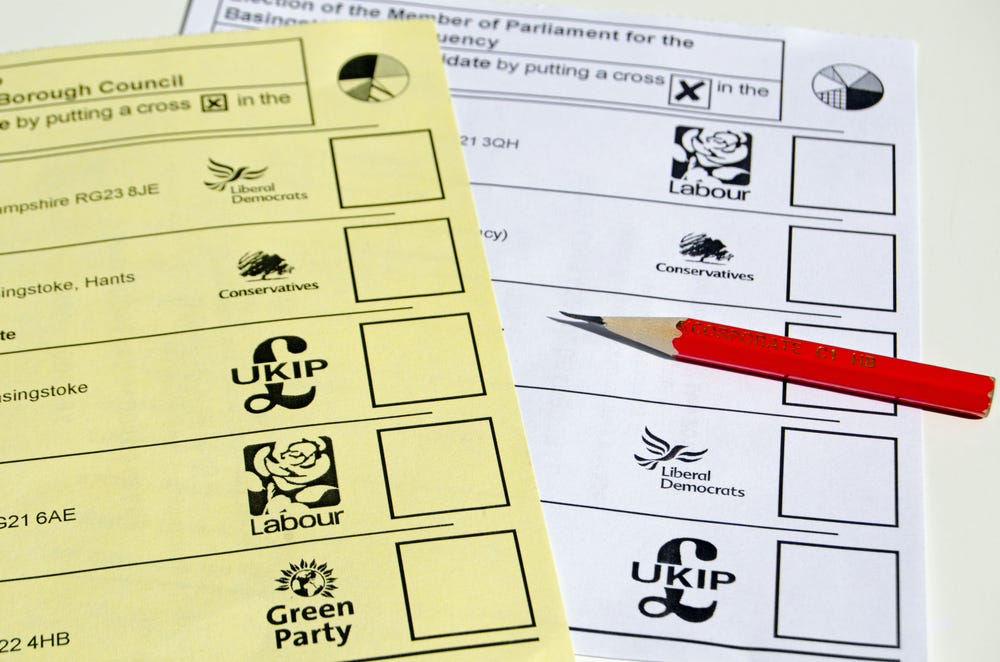
In this election, I am voting for a party that no longer wholly aligns with my values because we have two choices, The Conservative Party, or the Labour Party, (and I’ll be damned if the Tories get in, again, after 14 years of austerity that has turned the UK into, to use the politically correct terminology, an absolute shitshow).
If the electoral system was democratic, under a system of proportional representation as opposed to ‘winner takes it all’, first past the post, then I would be voting for the Green Party. The fact that I am writing this, the fact that I am saying that I am voting for a party that I do not want to vote for simply because ‘it’s the slightly better option’, surely that should be a blindingly obvious indicator that something is not right here, that our system of democracy is broken…
I say ‘fuck the Tories’ but I also want to say ‘fuck labour’, or rather, ‘fuck Keir Starmer’, the spineless, champagne socialist… But I can’t. I have to go to the polling booth on Thursday, putting a cross next to Labour just to get the Tories out.
And while I don’t have a gun held to my head, I do have the threat of the Tories getting in again going around and around in my head constantly, and the ever-present question of, ‘but what alternative choice do I have?’ there indefinitely.
Open your eyes, can’t you see? This is not democracy.
Yet will anything be done about it?
No.
Since the Second World War, all the Governments in the UK have been formed by either the Labour Party or the Conservative Party, as though they are the only parties we have… But they’re not. We don’t only have two choices when we vote.
Alas, I will be voting ‘tactically’ at this election to get the Tories out, but in five years time, at the next general election, I hope that we will have a more democratic system, that we won’t have to vote on who we don’t want in, but that we can vote on who we actually want in knowing that our vote will count for something.
Without representation, we have disillusionment, and it is when we become disillusioned with society that we all suffer.
Mentally, spiritually, and physically, we all suffer the consequences that come off the back of feeling powerless, our power to demand change deprived to us by the power-hungry who keep us in chains.
Five years…
We might not be there now but in five years?
Please, let there be change.
 ANARKISS