
I recently wrote an article exploring ‘why young people are moving out so late’, and in it, I spoke about how everything is happening later in life than it used to…
- Moving out of the family home,
- Getting married,
- Having children
(or not).
On the latter, my research showed that first-time mothers’ average age hasn’t changed over the years. A surprising discovery.
I told my Dad and he was surprised too.
‘When we were younger, everyone had babies in their early twenties.’ (including my mum who was 21).
So, that got me thinking, is there a discrepancy in the age of first-time mothers depending on where in the UK they’re from, the north-south divide, as I wrote about in this article, an influencing factor on yet something else?…
According to official data from the Office for National Statistics, in the UK at large, ie not accounting for a north-south divide, the average age of first-time mothers hasn’t really changed over the years…
In 1940, the average age of UK mothers was 29.3 years, compared to 26.4 years in 1973.
Since 1973, the average age has generally increased, but not at a remarkable rate.
In 2003, it was 27.
In 2013, 28.3.
As of today, 2024, the average age of first-time mothers sits at 30.6 (only a 1.6-year increase in 84 years)…
30.6.
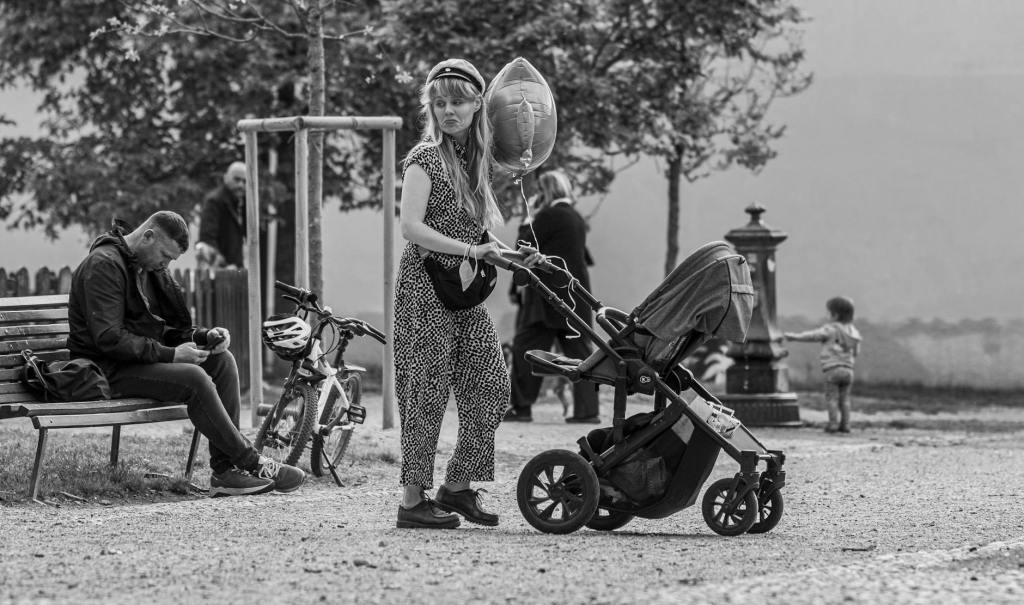
So why then, when I go into town, (Doncaster which, as of 2022 is officially a city, but most local people still refer to it as the shitty rundown market town that it is), do I see teen mothers pushing prams? Girls who I went to school with in parks with their toddlers? Why, when I was 16, did I personally know two girls who were pregnant? If the average age of first-time mothers is 30.6*, then why are all the signs here suggesting otherwise?
*(Take a decade off, and then some, and it might more accurately represent the demographic here in Doncaster)…
When we consider the irrefutable prevalence of the north-south divide and its effect on education for example, and thus job prospects and, ultimately, one’s overall quality of life, we can note that living up North does increase the chances of teen pregnancy.
When there is greater funding in the South, better education, and more opportunities in life, young people are more likely to delay having children so as to pursue their own careers. In the North, however, where those opportunities have historically been far fewer, with a lack of prospects and aspirations, people are more likely to have kids at a younger age, simply because they have no reason to delay/they have nothing that demands their responsibility.

Evidence of the difference in prospects in the North compared to the South can be seen in data from the 2021 census.
In 2021, 53.8% of Doncaster residents were employed, vs 74.7% of Londoners. The rates of unpaid work, however, were higher in Doncaster, with 4.1% of Doncaster residents reportedly providing up to 19 hours of unpaid care each week, vs 3.8% in London, the lowest proportion in the UK.
Statistics show that children in London and the South East are 57% more likely to attend university than students in the North (as of 2023), unsurprising when differences (inequalities) are prevalent throughout the entirety of the education system.

In 2022, the proportion of GCSE results graded 7 or above in the North East and Yorkshire and Humber was 22.4%, vs 32.6% in London.
And the differences don’t stop with compulsory education, either… At A-Level, the gap between the North East and South East was 8.7%.
When education is poorer in the North, so too are job prospects and thus earnings.
See the graph below to notice the trend.
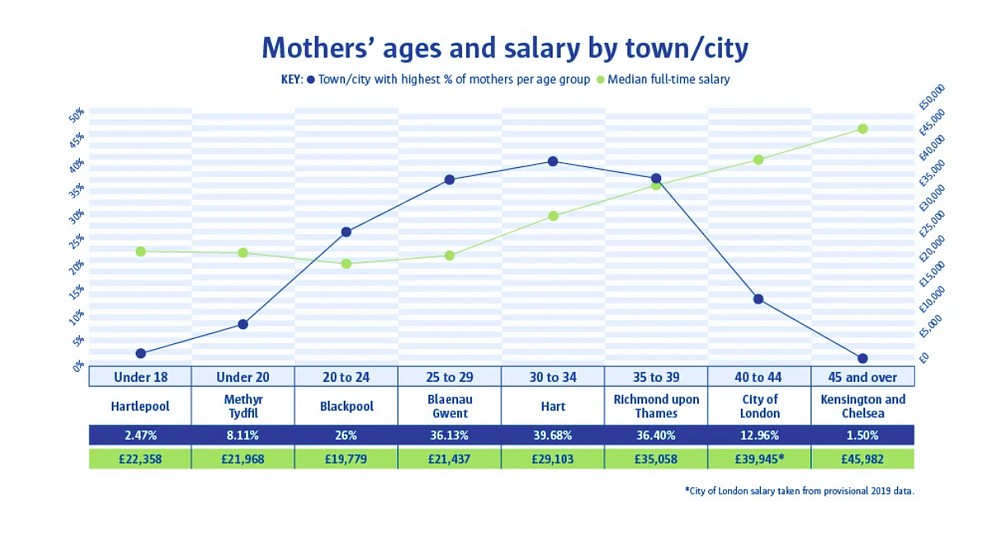
The regions with the youngest mothers also have the lowest median salaries.
In line with the theory that the richer you are, the greater job prospects you have (/the further South you are), the older you are to have children, according to data from Comparethemarket.com, Kensington & Chelsea, the richest local authority area in the UK, (where residents earn three times the national average, £64,868 per head), have the oldest mothers in the UK. At the other end of the scale sits Hartlepool. With an average salary per head of £25,000, Hartlepool has the youngest mothers in the UK.
To look at it more broadly, the North East and Yorkshire and the Humber have the largest percentage of mothers under the age of 30, as well as the lowest salaries of all the regions. London, on the other hand, has the highest median salary, as well as the largest proportion of mothers over the age of 30.
Clearly then, there is a correlation between earning potential and the age of first-time mothers.
Where earning potential is significantly higher in the South than in the North, so too is the age of first-time mothers higher in the South than in the North…
Late twenties, early thirties= South
VS
Late teens, early twenties= North.

Our life chances, our quality of life, should not so dramatically differ based on a one-hour 35-minute train ride (the time it takes to get to London from Doncaster).
The north-south divide gap must be closed to ensure that, regardless of where you call home in the UK, you have access to the same support, prospects, and opportunities as your Southern counterparts. Otherwise, the cycle continues;
Teen mothers giving birth to children who grow up in the same system.
With a lack of job prospects, teen pregnancy being seen as the ‘norm’, the children of teen mothers are more likely to become teen mothers themselves, ‘following family tradition.’ And so on and on and on (and on) the cycle goes. People in London queuing outside of Oxford and Cambridge with their 9 GCSE’s and A-level certificates in one hand, rolled up notes, ‘mummy and daddy’s trust fund’ in the other. Meanwhile people in the North queue outside of Mothercare, baby in one hand, benefits in the other, just enough to buy nappies for child number two (at the age of 22).
The fact that there is a decade difference in the age of first-time mothers in the North of England compared to the South, the fact that everything is different, worse off, in the North of England compared to the South, with wealth inequality only set to intensify, (the gap expected to reach £228,800 per head by 2030), proves just how divided we really are as a nation. When people talk of the UK as if London is all there is, forgetting us up here in the North, forgetting people in the Midlands who aren’t even factored into considerations of the north-south divide in many cases, we need (emphasis on ‘need’), greater equality.
 ANARKISS